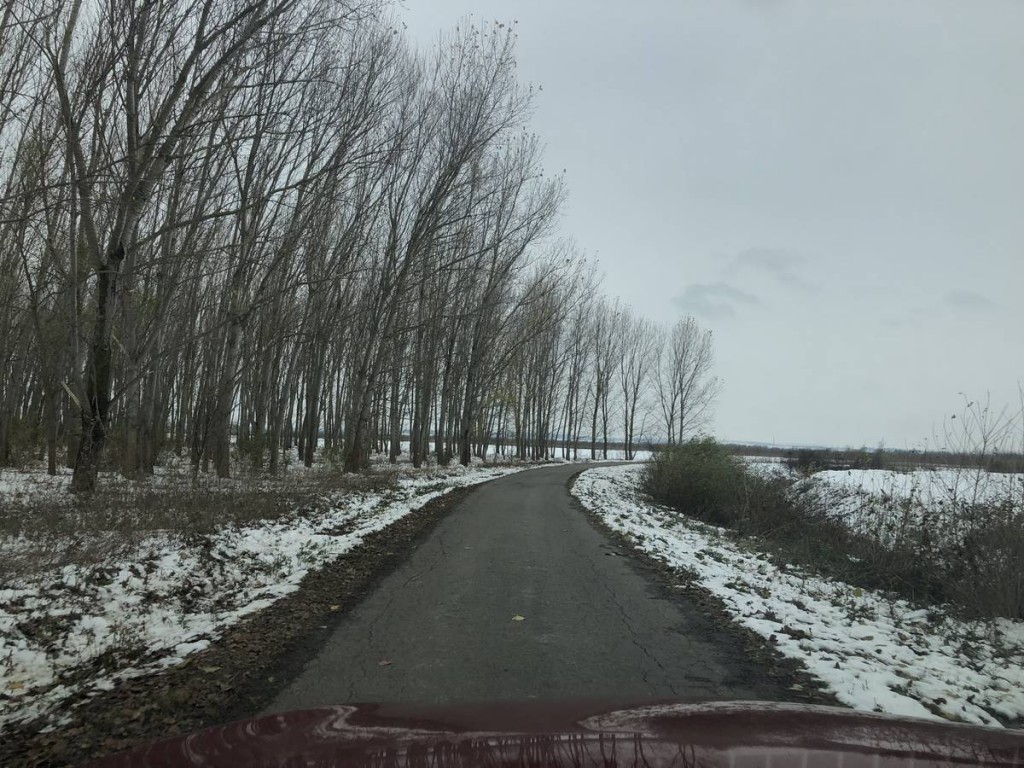
The route surrounds the Protected Area „See the Danube” and was declared the Natura 2000 site – has an area of 22,874 ha and is located in the continental biogeographical region, at the border between Giurgiu and Teleorman. It includes a sector in the Danube Meadow and the lower section of the Vedea River. Interestingly noteworthy is the fact that much of the area is arable land.
The protected area „Vedea Dunarii” is a Danube area with numerous islands (Gâsca island, Cama – Dinu – Păsrica islands), meadow forests, Pietrisu lakes, marshes, canals and reedbeds, with extremely important and interesting places for biodiversity .
It is an extremely beautiful natural area that is worth seeing on a bicycle route.
The route starts from Bujoru commune on DN5C and we head to Pietroşani, where we make a loop and we turn and go down the Danube until we intersect with Vedea River, then we head north towards the bank of Vedea river until we intersect with DN5C which will take us back to Bujoru.
60 years ago, on June 20, 1954, the metal bridge across the Danube connecting the cities of Giurgiu and Ruse, named after the Soviet insistence „Bridge of Friendship”, was at the moment the largest mixed bridge – road and rail – in Europe.
In the years 1950-1952, a building for club and cinema activities was built for workers involved in building the bridge. It continued to function as a cultural center, its scene being the host of the Giurgiu community for shows and celebrations.
On July 24, 2002, to celebrate the 138 years of institutional existence of the Border Police, the building became the headquarters of the Border Police Museum in Romania, the only institution of its kind in Romania.
Divided into six exhibition halls, plus the showroom, the institution hosts the permanent collection of the museum, made up of battle flags, the exhibition of historical frontier uniforms „De Veghe la Fruntarii”, the exhibition of current European uniforms, the river boats’ models Border Police, current weapons, and also during two world wars, epaulets, badges, decorations, historical publications, and a large painting representing the Battle of Calugareni.
The ensemble includes a series of monuments dedicated to all the heroes who lost their lives in the battles that took place in the territory of our country.
Initially, two monuments were built at the initiative of the inhabitants in 1905, in memory of the heroes who fell into the Independence War of 1877-1878.
Subsequently, the monuments of the heroes who fell in the two world wars were added. In 2013, they were rebuilt and re-upgraded.
Inside the ensemble was built a cross in memory of the hero Captain Daia Marin, who was born in 1919 in the village of Malu, Giurgiu County, and died in Blăjel commune, during the battles that the Romanian army wore in 1944, in the area Sibiu.
In 1836, two years after Alexandru Dimitrie Ghica (1834-1842), the king of Wallachia founded the city, the inhabitants built a wooden church celebrating St. Alexander, which soon became too small for all the inhabitants. Therefore, after a solid effort, the bishopric of the city managed to build, between 1869 and 1898, the present Cathedral, consecrated by Metropolitan Iosif Gheorghian on 6 December 1898.
The cathedral impresses with its architectural gravity, but also with the imposing size: 42 m long, 26 m wide, the maximum height in the tower is 45 m high. The cathedral has the shape of an inward cross and an exterior ship with a beautiful guarded portal of corinthian columns.
Above the narthex there are two towers, where are the bells and the clocks. The decorative elements specific to St. Alexander’s Cathedral are: the painting on the wall and the altar screen (in a neo-gothic style, 10 m high) executed by the painter’s team made up of Constantin Artachino, Constantin Pascali and the famous Stefan Luchian in 1898 in Byzantine style , in the oil technique. In the same year the pavement of the marble mosaic was placed. On the altar screen, they later added the icons of St. Spiridon and St. Philofteia.
The big chandelier, the small chandelier and the emperor’s candlesticks were made of golden bronze by the Weidekamp Kettling A.C house in Vienna, through its representative in Bucharest, Hans-Herzog. The holy church underwent major repairs after the earthquakes of 1940 and 1977.
Aquaventure is one of the largest thermal baths and spa parks in Teleorman County.
Access to the adventure park requires a fee of 10 lei and for renting a sun lounger you have to pay the amount of 2,5 lei. Beginning with the last week of August, access to the park is free of charge.
Services available in the park include a restaurant and theme parties. Aquaventure’s daily schedule is from 9:00 to 22:30.
Address: Strada Negru Vodă 100-102, Alexandria 140043
Telephone: 0247 312 904
Address: Street Oltului 32, Roşiori de Vede 145100
Phone: 0347 417 435
The „Danube On 2 Wheels” Project is co-financed by the European Union though the European Regional Development Fund, within the INTERREG V-A Romania – Bulgaria Programme.
The total eligible value of the project is EUR 497.713,26, of which EUR 423.056,25 represents the value of the European Union contribution through the European Regional Development Fund.
The content of this website does not necessarily represent the official position of the European Union. The initiators of the site are the sole responsibles for the information provided through the site.
www.interregrobg.eu
Route „Vedea – Dunare” Protected Area
Touristic objectives in area
Border Police Museum, Giurgiu
Monument of the Heroes, Giurgiu
St. Alexander’s Cathedral, Alexandria
Aquaventura Park, Rosiorii de Vede
Unicom Wine Cellar
President Guesthouse
Do you want more details?
- About the project
- AISSER
- Useful information
- Indicators
- „Danube on 2 Wheels” Tourist Center (ACTIS Sport Club – Calarasi)
- „Danube on 2 Wheels” Tourist Center ( „Sport for you and me – Sports Club Canoeing” Association – Belogradchik)
- Level – Medium / Advanced Duration – 1 day
- Distance – 30 km
- Surface – paved / unpaved
- Bicycle type – MTB


AdvancedSend a message