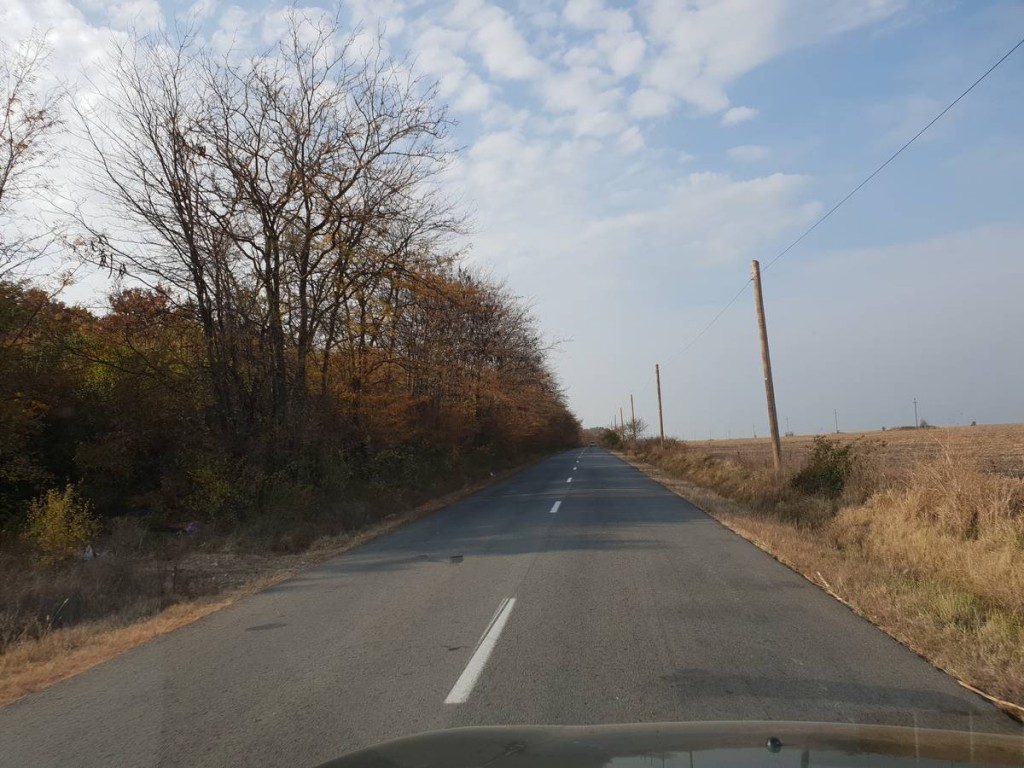
We leave Craiova on E79 next to Nicolae Romanescu Park and descend to the Jiu River passing through the villages Branişte and Green Balta to get to Podari village. We leave the village and leave E79 to continue the route along the forest road along Palululei Forest, pass along Harlea Walnut Plantation and climb towards DJ552A from where we continue on the asphalt along the Bucovăţ Forest to Bucovăţ commune, one of the most beautiful settlements in Dolj county. We meet here hill, plain, forest, Jiu meadow, old churches, just 6 km away from Banja Fortress. Bucovăţ is the favorite place for Craiova for holiday homes or for relocation with the whole family.
We cross Jiul and we reach the end of our route in Craiova.
Bucovăţ Forest is today the largest forest mostly unaffected by deforestation near the town of Craiova. The Bucovăţ forest is also known for the introduction of new species and is described by the forestry as a typical hill and plateau forest, rich in hornbeams and slats.
Bucovăţ village is located 6 km from the city of Craiova, on the county road DJ522 Craiova – Cetate.
The protected area is located in the village of Bucovăţ, on the DC97 towards the village of Carligei, about 200 m from the junction with the DJ552, on the property of Viorel Cerneanu.
The bloom is a vertical opening about 40 m high, predominantly sandy, on the western slope of Hârlige Hill.
The fossil deposit in Bucovăţ was first reported by L. Bielz and D. Czekelius naturalists in Sibiu in 1849.
Researches on the fauna and its position on the stratigraphic scale were later performed by one of the pioneers of the Romanian palaeontology, Radu Porumbaru.
In 1880, R. Porumbaru reported in Bukovăţ a rich fossil deposit of lamellibranchiate and gastropodode which he assigned to Levantina (the earlier name of Romania) and from which he gave the fossils of the great paleontologist Tournouër.
With a rich fossil shell of mollusks, dating from the Paleolithic, the Fossil Point in Bucovăţ deserves to be seen and photographed, representing at the same time the most important punctuation protected by law in the county of Dolj.
Dr. Mendel Memorial House is one of the buildings included in the list of tourist attractions in Dolj County, being built at the end of the 19th century.
The origin of the city’s current name is the subject of many controversies and floats in the legend; the only thing that can be said with certainty is that the name comes from the term in Slavonic „kral” which means king, gallant.
The Nicolae Romanescu Park in Craiova, one of the city’s landmarks, is the largest urban green space in Romania and one of the most representative monuments of landscape art in Romania.
Designed and built as a romantic park, fully designed and arranged by architects, the park was opened in February 1903 in the presence of King Carol I, Prince Ferdinand and Prime Minister Dimitrie Sturdza.
Nicolae Romanescu Park is located in the southern part of Craiova, at the end of the main street, Calea Unirii, in the 1 Mai neighborhood, forming a complex of about 100 hectares, unique in Romania.
The park hosts a host of valuable facilities of cultural and historical value: the Suspended Bridge, a very old bridge over a body of water separating two hills, still in operation; Magic Castle, located on one of the hills next to the bridge, which is a tourist attraction; the Craiova hippodrome, abandoned since 2000 and the Summer Theater that is part of a European renovation project. The park also hosts one of the oldest zoological gardens in Romania, which was opened in 1906.
Bania House, a monument of medieval architecture and the oldest secular building in Craiova, the capital of the Oltenia region, is the place where history blends with tradition. This is the only art monument in Oltenia – besides churches and monasteries – which represents Brâncoveanu style, some of its walls being more than 300 years old, and others even for over 500 years.
The building dates from the end of the 15th century, in 1496 becoming the headquarters of the Great Bank of Craiova, where the money (governors) of Craiova, which was the headquarters of the Oltenia region, were operating. Prince Matei Basarab and later martyr Constantin Brancoveanu (1699) rebuilt the House of Money (the headquarters of the money). Some repairs were made in 1933, but the real reconstruction took place in 1966.
Whoever visits the House of Banquet today has the chance to get acquainted with the traditions of Oltenia, thanks to the exhibitions belonging to the ethnographic section of the Oltenia Museum.
Address: Iancu Jianu 6 Street, Craiova 200142
Telephone: 0760 603 034
Address: Calea Severinului 7B, Craiova 200233
Phone: 0769 251 832
Address: Alexandru Macedonski 51, Craiova 200240
Phone: 0725 059 333
The „Danube On 2 Wheels” Project is co-financed by the European Union though the European Regional Development Fund, within the INTERREG V-A Romania – Bulgaria Programme.
The total eligible value of the project is EUR 497.713,26, of which EUR 423.056,25 represents the value of the European Union contribution through the European Regional Development Fund.
The content of this website does not necessarily represent the official position of the European Union. The initiators of the site are the sole responsibles for the information provided through the site.
www.interregrobg.eu
Route Craiova – Bucovăţ – Craiova
Touristic objectives in area
Bucovăţ Fossil Point
Memorial House Dr. Mendel, Craiova
Romanescu Park, Craiova
Bania House, Craiova
Euphoria Hotel
Flormang Hotel
Epoca Steak House & Wine Bar Restaurant
Do you want more details?
- About the project
- AISSER
- Useful information
- Indicators
- „Danube on 2 Wheels” Tourist Center (ACTIS Sport Club – Calarasi)
- „Danube on 2 Wheels” Tourist Center ( „Sport for you and me – Sports Club Canoeing” Association – Belogradchik)
- Level – Beginners
- Duration – 1 day
- Distance – 46 km
- Total vertical climb – 200m
- Surface – paved / unpaved
- Bicycle type – MTB



BeginnersSend a message