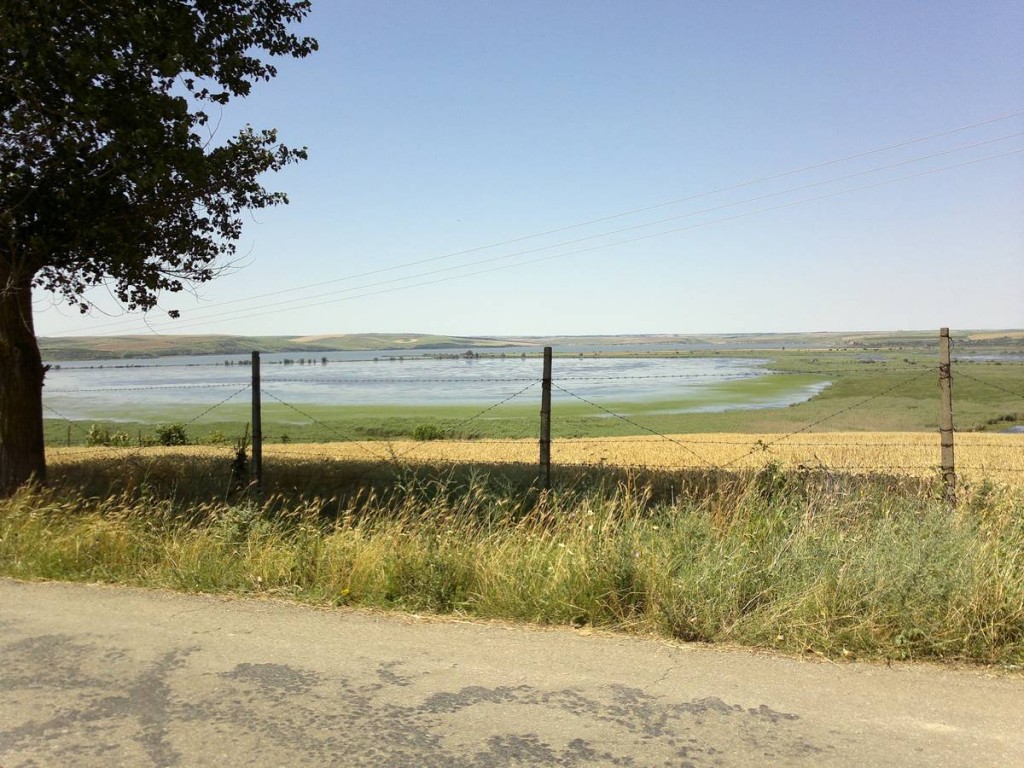
Departures from Monica (Hotel Baden) and walks along the bank of the Borcea branch to the Dervent Monastery, passing through the Ostrov commune. We leave DN3 at the Dervent Monastery and down the DC42 towards Galiţa and go along Bugeac’s shore to Gârliţa village until we reach Esechioi and from here we go back to Ostrov commune.
Lake Bugeac, also known as Lake Gârliţa, is the most southern Romanian river valley. It is not very deep, but its shores are steep, in some places reaching even 30 m high.
Lake Bugeac is practicing sport fishing and fishing competitions.
Restaurants and hotels identified on the bicycle routes in the county of Constanta.
Tropaeum Traiani is one of the most important ancient monuments on the territory of Romania.
Tropaeum Traiani – or „Traian’s Trophy” – was discovered in the early 1800s in Adamclisi in the former Roman province of Moesia de Jos (Romania today). It is one of the three Roman monumental structures on the site and is believed to have been dedicated by Emperor Trajan to his campaigns against the Dacians. It is an important commemorative monument that displayed the power of Roman revenge and communicated, in uncompromised terms, the presence of the Roman Empire in the region.
Built of stone and local concrete, Tropaeum took the form of a large cylindrical base on a platform that supports a conical roof; the „trophy” was initially placed on a hexagonal inscribed base, and depicted in stone a trunk of tree adorned with various equipment – weapons, standards, and prisoners – of war.
The height of the monument, including the attached trophy, is approximately equal to the diameter of the socket foundation, rising to about 40 meters.
It is said that Tropaeum was conceived to celebrate Trajan’s successes in the Dacian campaigns of 101-102 and 105-106 AD. This is confirmed by the iconography of the metopes that seem to give rise to war scenes between the Romans and the Dacian tribes. Surrounding the socket are also found 48 of the 54 original rectangular plates, known as metopes, engraved with scenes of war. Located above the plates there is a 26-creeper frieze, of which only 23 have been preserved.
Since 1977, the Tropaeum Trajani monument has not been restored. But in 2012, Constanta County officials won a European project that allowed them to carry out a complete restoration of the monument, whose structural foundation was badly affected. The original elements are exposed to the Adamclisi Museum and await visitors.
Nowadays Ostrov has an area of approximately 2,000 hectares with a 1,200-acre wine area, 400 hectares of orchards (apricots, peaches, apples, plums, cherries, nuts), 150 hectares of arable land, and 200 of hectares of greenhouse. The Ostrov areas include the two major centers: Ostrov, with a total of five farms and an area of approximately 600 hectares and Lipnitsa, with a total of nine farms and an area of approximately 1,000 hectares.
The Ostrov domains are located in the southwestern part of Constanta County, along the right bank of the Danube, on the upper terrace, with a length of 30 km.
The wines obtained in this cellar have peculiarities of nobility and originality, which give them a strong and special personality. The wines from the Ostrov cellar follow and promote the European Union’s quality demands. Archaeological sources have shown us that, even 3,000 years ago, the region known today as Ostrov was synonymous with viticulture and, therefore, with winemaking. Over time, in different forms, wine was produced at Ostrov.
The types grown in the Ostrov Domains are the following: Merlot, Cabernet Sauvignon, Black Feteasca, Pinot Noir, Syrach and Rebo for red wines.
For white wines, the types are: Sauvignon Blanc, Chardonnay, Pinot Gris, White Feteasca, Royal Feteasca, Italian Riesling, Muscat Ottonel and Cramposie.
The most important wines of the Ostrov Domain brand are: Ostrov Reserve Domains, Durostorum Fortress, Canaraua Fetii, Sunshine, Ostrov Domains, Awarded, Labyrinthum and Ostrov Winery.
The Murfatlar domain came into possession of the Kogalniceanu family in 1885, when the great politician and writer Mihail Kogalniceanu acquired the real estate from Hagi Mehmet Aralam, a member of a prosperous family of farmers in Constanţa County.
The mansion is built in an eclectic style, featuring details of the western style of the 19th century, as well as visible elements of the Moorish style in the case of the chandelier or crenellated tower.
Although he recently underwent a reorganization and re-running process, he was ready to host kindergarten no. 2 in Murfatlar, the building still preserves original wooden pieces and pieces.
The construction is one of the few Romanian mansions in the modern age preserved to date and is classified as a historical monument in the Dobrogea region.
The mansion is surrounded by a park where the Trinity Post built in 1943 is located in the memory of those who were lost on the front.
His Eminence Archbishop Tomis-Theodosius, knowing that Capidava was an episcopate dating from at least the beginning of the 6th century, decided to establish here a monastery of nuns with community life in Capidava. Thus, the monastery was established in 2007 and continues to grow and grow.
The patron saints of the Capidava monastery are the martyrs Epictet and Astion, whose holy relics dating back to the last decades of the third century were discovered in the ruins of Halmiris Citadel in Tulcea County, near the Danube arm of St. George, where the two martyrs died for Christ and His gospel. The martyrs of Astion and Epictet are celebrated on July 8, this time being the patronage of the Capidava monastery.
The house was built by the Greek painter Theodor Russo at the end of the 19th century.
The architecture of the building is influenced by the neoclassical style of the architect Pelopidas Couppa.
Built on four levels, the building has a basement and an attic, both higher. The socket was made of medieval extraction stone. Entrance doors are wooden and have a neoclassical style, is decorated with denticulate and capital, place inscribed monogram „TR”. Thus, the visitor can identify both the name of the original owner, the Greek Theodor Russo, and the year of construction, 1897.
The building is distinguished by its vertical symmetry, accentuated by windows. Each of the windows on the ground floor is equipped with a gable with acrotere (socket is placed on a frontron to support statues, vases and other ornaments) supported consoles in its upper part.
Above them are windows architrave (a typical construction element for classical architecture – which constitutes the bottom of the coping and which is supported by the column or the column head wall) supported by the console – Kariatidas, the same number typology.
Above the entrance doors can be seen two balconies with a simple hardware, supported from the side. A console supported by consoles is highlighted with spiral ornaments and a narrow frieze with leaves. Upstairs, between the windows one finds a hard-to-read inscription in Greek.
It is the largest complex for extreme sports practitioners in Romania. The total area of over 8,500 square meters is divided into 4 extreme sports areas for the following activities: rollerblading, skateboarding, BMX, MTB, mountaineering, bouldering, trial, jumping and scooter.
Located near Lake Tabacarie, the Gravity Park sports complex has become a popular recreational activity among the young and extreme sports lovers in Constanta.
Whether you are a beginner or an advanced, if you want to go out to practice such a sport or just want to relax, Gravity Park is the right place for you.
Visitors and sportsmen have a range of facilities such as sports equipment rental, climbing courses, spectators’ stands, professional sound system, toilets, showers and cabinets.
The official opening took place on May 24, 2008, with an extreme show, attended by the best athletes from Romania. Besides the demonstrations of rollerblading, skateboarding, trials, dirt jump and fast climbing, a Best Trick contest with total prizes worth 3,000 euros was also held. Since then, competitions of this kind have taken place every year.
Entrance to the park is free of charge.
For those who are not 18 years of age, parental consent is required to enter these extreme sports areas. They must complete a written statement and accept the rules of the complex.
Access is free for all those with adequate sports equipment and a badge of access. Also, the helmet is mandatory.
Protective equipment (helmet, knees, armrests, gloves) and all necessary climbing equipment (rope, harness, rags, boots, carabiners) can be rented.
You can come to the park with your own helmet. However, in the case of personal climbing equipment, it must be checked by the mountaineer at Gravity Park before climbing the tower.
Located in the heart of the Murfatlar vineyard, the museum was founded in 1970 under the patronage of the National History and Archeology Museum in Constanta.
In the museum there are dozens of exhibits of remarkable value, which certify the practice of wine culture on the territory of Dobrogea for more than 2,000 years. Stopping in the times when the grapes crushed with their feet in stone tanks to get the drink, we remember the robustness of the Dacians who drank the wine without mixing it with water.
Instead of the silver or gold cups, the Dacians served wine from wooden pots, from large deer horns that passed from hand to hand.
Some historians believe that the grape planting in the area is preceded by the cultivation of the first grain, and historical references to Proto-Dacian wine and whether it was made by Strabo and Diodorus in Sicily.
The „Dinu and Vintila Sevasta” Art Museum is organized in Topalu, based on the collection donated to the native community by Dr. Gheorghe Vintilă, the son of Dinu and Vintila Sevasta.
The museum is organized in the 13 rooms of the former home of the donor parents, teachers from Topalu. The art museum is unique in rural Romania, with 228 paintings, sculptures and graphics belonging to well-known artists including: Ioan Andreescu, Octav Bancilă, Nicolae Grigorescu, Ştefan Luchian, Gheorghe Petraşcu, Nicolae Tonitza, Alexandru Ciucurencu, Dimitrie Paciurea, Cornel Medrea, Teodor Aman, Corneliu Baba, Nicolae Dărăscu.
Among the Topalu exhibits are the famous Child Head and Female Head, both belonging to Master Tonitza. Together with the works of Nicolae Grigorescu, the works of Stefan Luchian and other great Romanian painters, the Vintilă collection holds valuable paintings.
Among the exhibits one can also admire one of the most recent paintings by master Grigorescu from the series Caru cu Boi. Specialists consider Boat Boat one of the best-selling Romanian paintings of all time.
The painting exhibited at Topalu is made by the great artist towards the end of his life, and the fine lines and the composition of the color have led critics to launch the idea of an illness of vision, with which Nicholas Grigorescu fought until the end of his life.
In the courtyard of the museum house is the tomb of the doctor Gheorghe Vintilă, respecting his final desire, mentioned in the donation document of the valuable art collection. In the museum’s archive there is a set of personal notes that recorded the history of the possession of each piece of art in his famous art gallery.
The museum was reopened on September 25, 2007, after being rehabilitated. The rehabilitation operation consisted in restoration of the roof, the roof, as well as the replacement of pavement, carpentry and equipment with the micro-ventilation system, necessary for keeping the exposed paintings in optimal conditions.
The Târguşor Heroes Monument was built in memory of those who fought and lost their lives in the battles that took place between 1916 and 1918:
• The Battle of Turtucaia
• The Battle of Topraisar
• Battle of Marasti
• Battle of Marasesti
The Geological Reservation Gorge of Dobrogea has a total area of 10,929 hectares.
The site is important not only because of its geomorphological, paleontological, botanical and landscape features, but also because of its fauna.
Limestone found in the keys is the remains of the atolls that justify the semi-round form of the walls. The walls are oriented East / West and do not have a height of more than 40m.
The limestone plateaus with strange shapes, struck by the passage of water, surround the road on one side and the other. Together with the natural beauties, the area is strewn with numerous archaeological traces, especially those discovered in the caves along the Keys of Dobrogea – remnants of tools, hunting and even osteological traces of the type of people who inhabited this territory in the prehistoric age. Along the entire expanse of the Dobrogea Keys, there are many beautiful natural attractions, such as ravines or caves sculpted in limestone: The La Adam Cave, Bats Cave, The old woman Cave, Casian Cave or The Grotto Cave.
Address: DN3, (near Baneasa – Constanta), 907165 Lipnitza
Address: Str. Dacia nr. 72 – Cernavoda
Telephone: 0241.630106
Address: Bdul Alexandru Lapusneanu No. 184b, Constanţa
Phone: 0241 517 051
Address: Street Adamclisi 1A, Constanta 900001
Phone: 0726 329 905
Address: Street Dunării Nr. 494b, Topalu 907280
Telephone: 0723 046 002
Address: Constanta, DC44, Ostrov
Telephone: 021 344 1461
Address: DN3 41, Adamclisi 907010
Phone: 0766 191 369
Address: Aleea Trandafirilor, Murfatlar
Telephone: 0241 232 000
The „Danube On 2 Wheels” Project is co-financed by the European Union though the European Regional Development Fund, within the INTERREG V-A Romania – Bulgaria Programme.
The total eligible value of the project is EUR 497.713,26, of which EUR 423.056,25 represents the value of the European Union contribution through the European Regional Development Fund.
The content of this website does not necessarily represent the official position of the European Union. The initiators of the site are the sole responsibles for the information provided through the site.
www.interregrobg.eu
Ostrov – Dervent Monastery Route
Touristic objectives in area
The Monument of Trophaeum Traiani, Adamclisi
Ostrov wine cellar
Mihail Kogalniceanu Mansion
Monastery Epictet and Astion, Capidava
Theordor Russo House, Constanta
Gravity Park, Constanta
Wine Vineyard and Museum, Murfatlar
The Art Museum, Topalu
Monument of the Heroes, Târguşor
The keys of Dobrudja
Dionis Hotel, Lipnița
Hollywood Hotel, Cernavoda
Zodiac Hotel Restaurant
Integra Restaurant
Darie Winery – Vinum Capidava S.R.L.
The Lying Jackal Den (Bârlogul Șacalului Mincinos) Guesthouse
VASILE E. DANIEL Sole Trader
La Povești Garden Restaurant
Do you want more details?
- About the project
- AISSER
- Useful information
- Indicators
- „Danube on 2 Wheels” Tourist Center (ACTIS Sport Club – Calarasi)
- „Danube on 2 Wheels” Tourist Center ( „Sport for you and me – Sports Club Canoeing” Association – Belogradchik)
- Level – Beginners
- Duration – 1 day
- Distance – 27 km
- Surface – paved
- Bicycle type – cursor


BeginnersSend a message