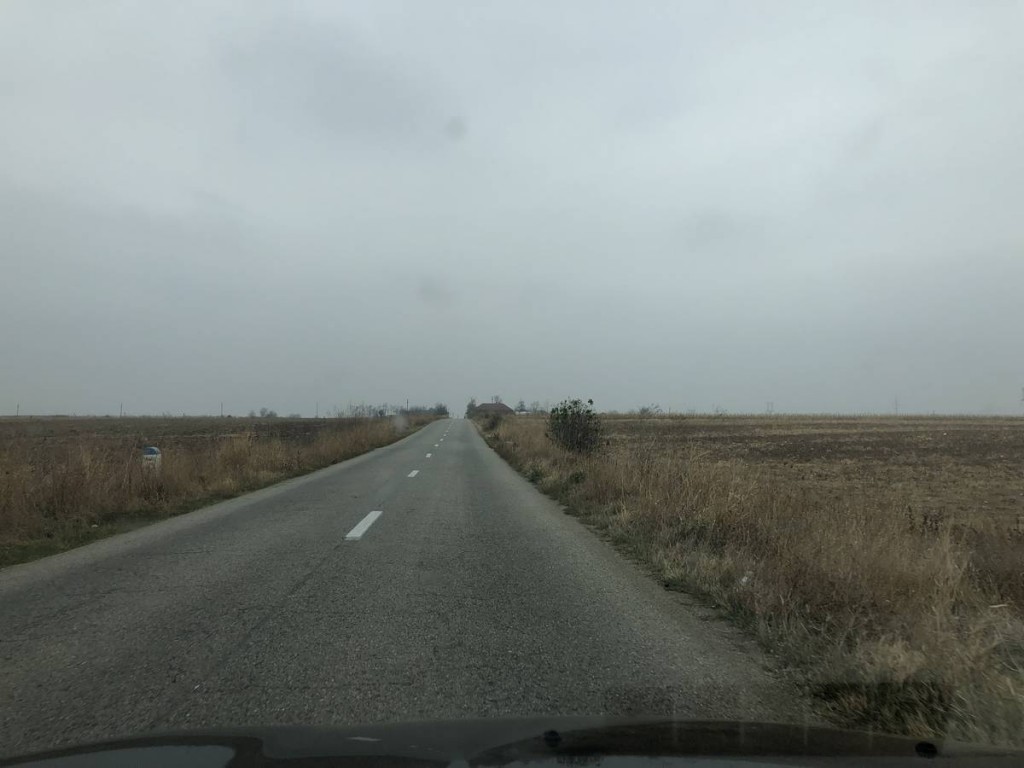
We leave Slatina on DJ546 towards Brebeni village and keep this road until Drăgăneşti-Olt, passing through the villages of Coteana and Bălăneşti, then through Mărunţei commune and Comani village to Drăgăneşti – Olt. We are about midway, so we can search here in Drăgăneşti Olt for a nice terrace or restaurant where we can eat and have a drink to get some rest.
From Drăgăneşti Olt we take the DC120A crossing the Olt River towards Fărcăşele commune from where we climb DJ642 to the village of Reşca, to get to the Dobrosloveni commune – here is the Folk Festival „Plai De Romanate”. From Dobrosloveni we climb DN64 towards Osica de Sus and Brâncoveni. We go up to Piatra and then go through Ntuleşti, Ennoşeşti and Oltişoru to get to Găneasa. From Găneasa we take the DJ65 and pedal 9 km to reach Slatina, crossing the Olt river.
In 1969, the museum in the town of Slatina was enriched with a new section of folk art that was added to the history section created in 1952 and constantly developed since then.
At its foundation, the ethnography department had a heritage of 1,480 objects, a heritage that has been steadily enriched, reaching 33 years since its inception, to a total of 8,933 objects.
This ethnographic heritage reflects popular creation from almost all villages and communes in Olt County, a territory where three ethnographic areas meet: Olt, Romanati and Boian Plain.
Monastic tourism in Olt County is represented by well-preserved buildings, of which we mention:
The Clocociov Monastery dedicated to the Archangels Michael and Gavriil is one of the oldest monastic units in Romania. Its beginnings, without being recorded in the documents at that time, were lost with the passage of time.
Some of the found documents certify the founder of the monastery Prince Mihai Viteazul.
The old church building began in 1645 and lasted a few months.
The painting that can be admired today in the monastery is new and was made in 1937 by the painter Nicolae Pană. From the old painting, the votive painting, a remarkable portrait of the founders and their immediate descendants, is still preserved in the narthex.
Inside the building was also arranged a museum with an important collection of old Romanian art, including icons, decorative art pieces (especially silverware, embroidery, fabrics and wooden sculptures) and wooden engraved books in the most popular printers from the country of famous Romanian artists.
The founder of the Strehareţ hermitage was Bishop Seraphim the First of Buzau and from 1668 Bishop of Râmnic.
The construction of the hermitage began in 1665, and on August 4, 1668, Serafim consecrated the founding of the Metropolitan Church of Bucharest, where he was the pastor of Metropolitan Theodosius.After 1865, the Streharets hermitage led a quiet life without major events.
The frescoes of the hermitage are important through the Neo-Byzantine painting style and Cyrillic writing, which is preserved on the frontispieces of the wall icons. Many of the hermitage icons are living documents, with time stamp, icons that, despite the weather, are still beautiful and well preserved.
In 1979, the old tower of the bell was demolished and a new bell tower was built above the portal at the entrance to the monastery.
History lovers and people looking for unique places can find in the courtyard of the Boian Plain Museum in Drăgăneşti-Olt a unique place in Romania and even in Europe, as Professor Traian Zorozoliu argues in the form of a Neolithic outdoors settlement , specifies the ancient culture Gumelniţa.
„It is fascinating for anyone in the country, whether or not to be in love with history, to enter into a village of 4,500 years old, which is the only village of its kind in Romania and Europe at the same time. 24 European countries have come and said it is the most successful reconstruction If we had bigger spaces I could have done more. But it is a beautiful building because here you can walk and discover another world, another way of interior design, a different lifestyle, „says Professor Zorzoliu, director of the Boian Plain Museum in Drăgăneşti-Olt, about the archaeological park he created four years ago.
The Neolithic Archaeological Park of the Drăgăneşti-Olt Museum Complex was opened in 2010. The Neolithic Village is made up of six real-sized huts built in open space on a surface surrounded by a defense ditch and a wicker fence. Access to the village is done on a narrow bridge. Inside the huts there are tools used in the Neolithic trades, such as fishing, agriculture, ceramics and hunting.
Address: street Crisan nr. 1, Slatina 230008
Phone: 0249 430 390
Address: Street Ecaterina Teodoroiu 1, Slatina 230022
Phone: 0349 881 010
Address: Alexandru Ioan Cuza Bulevard, Slatina
Phone: 0249 438 310
Address: DJ546, Drăgăneşti-Olt 235400
Phone: 0740 858 582
The „Danube On 2 Wheels” Project is co-financed by the European Union though the European Regional Development Fund, within the INTERREG V-A Romania – Bulgaria Programme.
The total eligible value of the project is EUR 497.713,26, of which EUR 423.056,25 represents the value of the European Union contribution through the European Regional Development Fund.
The content of this website does not necessarily represent the official position of the European Union. The initiators of the site are the sole responsibles for the information provided through the site.
www.interregrobg.eu
Route Slatina – Găneasa – Slatina
Touristic objectives in area
Ethnography Museum, Slatina
Clocociov Monastery, Slatina
Strehareţ Monastery, Slatina
Drăgăneşti-Olt Archaeological Park
Park Hotel, Slatina
City Hotel Slatina
Deja Vu Restaurant
Spicul Guesthouse
Do you want more details?
- About the project
- AISSER
- Useful information
- Indicators
- „Danube on 2 Wheels” Tourist Center (ACTIS Sport Club – Calarasi)
- „Danube on 2 Wheels” Tourist Center ( „Sport for you and me – Sports Club Canoeing” Association – Belogradchik)
- Level – advanced
- Duration – 1 day
- Distance – 82 km
- Total vertical climb – 100 m
- Surface – paved / unpaved
- Bicycle type – MTB on dikes / pavements on paved roads


AdvancedSend a message